 Members area
  Members area

Recommendations for Interview Preparation—An example of the pharmaceutical industry
Article author: Anastasiia Maksymenko, Eirhub’s Co-founder, Recruitment Partner (Pharma, Biotechnology, MedTech)
A minimum of 5% of the time I spend on a recruitment project is dedicated to preparing candidates for each stage of interviews with the client. I believe this procedure is essential as it provides candidates with greater self-confidence and a sense of support while allowing the client to distinguish candidates from Eirhub.
At the same time, this process is designed to be fair to the client. We never provide the candidate with information that could give them an unfair advantage. For the Eirhub recruiting team, this is always about having a clear procedure and understanding our clients, their businesses, and creativity, as even within the structure of one company, we may have different vacancies, departments, countries, and hiring managers.
The classic interview structure is a format where the introduction begins with the client (potential employer) presenting the company, interviewers, and the vacancy, and ideally outlining the sequence of actions and timelines.
It is important to note that each company may have its own interview structure; the above describes the classic format I mostly encounter. Additionally, it is worth noting that below is an example of communication with a potential employer, where both recruiters and the direct supervisor may be present at a hypothetical interview. In any case, the information described below will be helpful for different compositions of interviewers.
In preparing candidates, we mainly focus on the following points:
- Company (general description, therapeutic areas, products, latest news).
- Interviewers (LinkedIn profiles, interviewers' experience, their posts, contacts, recommendations).
- Typical questions.
- Competency-based questions.
- Candidate's questions for the company.
(1) COMPANY
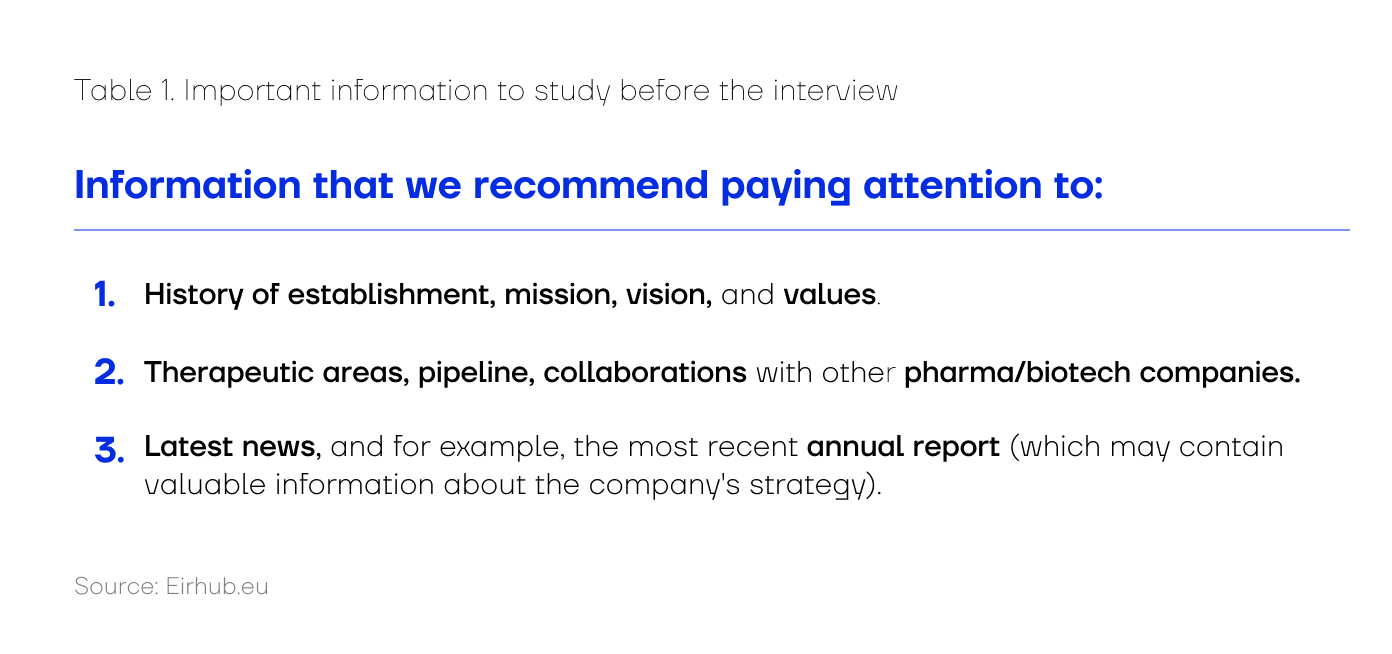
The candidate certainly knows general information about the company because this interview was planned in advance. However, we advise conducting a more thorough study of all publicly available information because, firstly, it is interesting, and secondly, potential employers always appreciate the candidate's interest and preparedness. Such initiative is the first criterion demonstrating motivation.
Information that we recommend paying attention to:
(2) INTERVIEWERS
You can get information about the client's representatives (interviewers) from the recruiter/agency consultant or the potential employer's internal recruiter/hiring manager. Knowing their names and positions, you can easily find helpful information that will allow you to familiarize yourself in advance with potential colleagues. For example, on LinkedIn, we recommend paying attention to the following:
- Their LinkedIn profiles (presence and completeness).
- Experience (time working, previous companies, career progression, intersections of experience between potential colleagues/managers and the candidate in therapeutic areas/products/companies, etc.).
- Posts. If there is activity, what is the nature of the posts?
- Contacts, mutual connections.
- Recommendations. Has the person given and received recommendations? If so, what was written?
(3) TYPICAL INTERVIEW QUESTIONS
I usually don't ask candidates about their plans for the next 5 years, but this question may come up in some interviews with clients (especially for positions in Europe). At the same time, it's necessary to try to consider all possible potential questions, so my subjective list looks like this:
- "What do you know about our company/products/projects?"
- "What attracted you to this role, and why did you decide to apply?"
- "What skills and experience make you the most suitable candidate?"
- "What are your strengths and weaknesses?"
- "What factors influenced your decision to change companies in the past? Why did you leave your last employer?"
- "What drives and motivates you in your professional endeavors?"
- "What are your expectations for this role, your potential manager, and the company?"
- "What can we do to ensure you succeed in the role if we hire you?"
- "How do you deal with stress?"
- "How do you handle conflict situations?"
- "What are your hobbies?"
- "What are your financial expectations and other compensation and benefits package components?"
(4) COMPETENCY-BASED QUESTIONS
If you have a job description or a vacancy description, you can analyze the requirements and competencies emphasized by the potential employer and figure out examples of questions they might ask to assess specific competencies. Here are some examples:

If you want to explore soft skills more deeply, you can visit competencylibrary.com, which provides examples of questions for various competencies.
If the potential employer is a foreign company and you are being interviewed for positions in Europe, you can use platforms such as Glassdoor and Indeed to find examples of interview questions from specific companies based on information shared by other candidates.
(5) Questions Candidates Should Ask the Company
Asking questions as a candidate can indicate your interest and motivation. It also provides you with the opportunity to gain valuable insights that can help you make a decision in the final stage. It's best to ask your questions at the end of the interview, after the main topics, like an introduction to the company and the candidate, have already been discussed.
Examples of questions for the company include:
- How did this position become available?
- What is the department's structure, and to whom will I report?
- How quickly are you looking to fill the position? What is the timeline for the hiring process, and what are the next steps after this interview?
- What were the main reasons for rejecting other candidates?
- Is remote or hybrid work being considered for this position?
- What are this position's key goals and objectives in the first three to six months?
- What are the components of the compensation and benefits package?
The presence of questions is essential, but it's crucial to consider the timing, relevance, and quantity of questions. Feel the room and gauge the situation. After the interview, you can always clarify anything that interests you with either the recruiter or the hiring manager.
Best of luck with your preparation!
And join Eirhub's LinkedIn company page for more insightful updates!

our Brochure